Best Water Filter Pitchers for Cleaner Tap Water
A water filter pitcher is one of the simplest upgrades in a well-run kitchen: it sits in the fridge, it asks very little of you, and it can improve the taste of tap water while reducing certain contaminants. The useful distinction is not which pitcher looks the most "eco" on the box. It is which filter is independently certified for the job you actually need, and whether you will replace that filter on schedule.
This buying guide gathers highly rated pitchers and explains how to read certifications, what NSF/ANSI standards cover, and which style fits a small household versus a busy fridge. Prices change often, so use the buttons to check today's price.
Quick picks
- Best long-life everyday pitcher: the Brita 10-Cup Elite, with a certified Elite filter that lasts longer than Brita's standard cartridge.
- Best for dissolved solids and PFAS: the ZeroWater 10-Cup, which includes a TDS meter so you can see when the filter is spent.
- Best certified PUR option: the PUR PLUS 11-Cup, designed for PUR's PLUS filter, which is certified to reduce lead and total PFAS.
- Best longer-interval filter: the Epic Nano XP, a 10-cup pitcher with a 100-gallon stated filter life.
- Best for a broader lab list: the Clearly Filtered 10-Cup, if you are willing to read the maker's lab reports alongside its formal certifications.
How the pitchers compare
Pick | Best for | What stands out | Shop |
|---|---|---|---|
Brita Elite 10-Cup | Everyday use with a longer-life filter | Independently certified Elite filter for lead and chlorine taste | |
ZeroWater 10-Cup | Reducing dissolved solids, including certain PFAS | Five-stage filter plus a TDS meter | |
PUR PLUS 11-Cup | Certified lead and total PFAS reduction | Designed for the PUR PLUS filter | |
Epic Nano XP | Fewer filter changes | 100-gallon stated filter life | |
Clearly Filtered 10-Cup | A longer published lab list | Broad third-party tests; narrower formal certifications | |
Brita with BritaPlus | Brita's newer higher-reduction filter | Ships with the BritaPlus cartridge |
What to look for in a water filter pitcher
Start with your water, not the marketing
If you are on a public water system, begin with the consumer confidence report your utility already publishes. If you have a private well, or you have a specific concern such as lead in an older home, consider testing before you shop. EPA's advice on protecting your tap is a practical place to start, and its pages on home drinking water treatment explain what different filters can and cannot do.
A pitcher will not replace a whole-house system, and it will not fix every problem. It is a point-of-use filter for the water you drink and cook with.
Trust independent certifications
Look for certifications to NSF/ANSI standards by a recognized body such as NSF, WQA or IAPMO, and match them to the exact filter, not just the pitcher brand. NSF's consumer guide to home water treatment is a clear overview. In short:
- NSF/ANSI 42 covers aesthetic effects, including chlorine taste and odor.
- NSF/ANSI 53 covers health-related contaminants such as lead, when that specific claim is listed.
- NSF/ANSI 401 covers certain emerging contaminants, including some pharmaceuticals, when listed.
- A PFAS claim should name PFOA, PFOS or total PFAS and appear in the current certification listing.
Maker lab reports can be useful extra evidence, especially for a longer contaminant list, but they are not the same thing as a certification. When the two disagree, treat the certified claims as the firmer ground.
Filter life matters as much as the first pour
A filter that is certified for 120 gallons and one that is certified for 15 or 40 gallons will feel very different over a year, in both cost and waste. Replace the cartridge when the maker or the TDS meter says so. An exhausted filter does not keep performing at its certified level, and it is the filters, not the pitcher body, that usually create the ongoing waste.
Size, speed and materials
A 10- or 11-cup pitcher suits most households; a larger dispenser makes sense if you fill glasses all day. Glass or BPA-free plastic both work if you will actually wash and refill the pitcher. Faster flow is more convenient; some of the more thorough filters pour more slowly. That is a fair trade if you fill the pitcher after dinner and drink it the next day.
The pitchers, in detail
Brita 10-Cup Elite
Brita's Elite pitcher is the easy recommendation for many kitchens: a familiar 10-cup format and a longer-lasting Elite filter that is independently certified to reduce lead, microplastics and chlorine taste and odor. It is not automatically the right filter for every PFAS concern, so check the current listing if that is your priority.

Brita 10-Cup Elite Water Filter Pitcher
Brita's 10-cup Elite pitcher pairs a familiar, fridge-friendly design with a longer-lasting Elite filter that is independently certified to reduce lead, microplastics and chlorine taste and odor.
Pros
- Elite filter is certified for lead reduction
- Longer stated filter life than Brita's standard filter
- Easy everyday pitcher format
ZeroWater 10-Cup
ZeroWater's 10-cup pitcher uses a five-stage ion-exchange filter and includes a TDS meter, so you can measure residual dissolved solids and know when to change the cartridge. It is widely used by people who want a very "flat" taste and certified reductions of lead and certain PFAS. The trade-off is a shorter filter life than many carbon pitchers, so budget for more frequent replacements.

ZeroWater 10-Cup Water Filter Pitcher
A 10-cup pitcher with a five-stage ion-exchange filter designed to reduce dissolved solids, including certified reductions of lead and certain PFAS, plus a TDS meter so you can see when the filter is spent.
Pros
- Includes a TDS meter
- Certified for lead and certain PFAS
- A widely used 10-cup size
PUR PLUS 11-Cup
The 11-cup PPT111W is built for PUR's PLUS filter, which is independently certified to reduce lead, total PFAS and chlorine taste and odor. If you want those health claims in a certified pitcher, this is one of the more straightforward options. Be sure you are buying PLUS filters, not PUR's basic cartridge, when you restock.

PUR PLUS 11-Cup Water Filter Pitcher
An 11-cup PUR PLUS pitcher (model PPT111W) designed to take the brand's PLUS filter, which is independently certified to reduce lead, total PFAS and chlorine taste and odor.
Pros
- Designed for the PUR PLUS filter
- Certified PLUS filtration for lead and total PFAS
- A slightly larger everyday pitcher
Epic Nano XP
Epic's 10-cup Nano XP pitcher is aimed at people who would rather change filters less often. The maker rates the cartridge at 100 gallons. As always, read the current certifications and lab reports for the exact claims you care about, rather than relying on the headline number alone.

Epic Nano XP 10-Cup Water Filter Pitcher
A 10-cup pitcher from Epic Water Filters with a 100-gallon Nano XP filter, aimed at households that want a longer interval between replacements.
Pros
- 100-gallon stated filter life
- 10-cup everyday size
- Replacement filters are sold separately
Clearly Filtered 10-Cup
Clearly Filtered publishes extensive third-party lab testing for a long list of contaminants, which is why it appeals to shoppers who want a broader filter. Its formal certifications are narrower than that lab list, so this is a pitcher to buy with your eyes open: read both documents, then decide whether the extra testing is worth it for your water.

Clearly Filtered 10-Cup Water Filter Pitcher
A 10-cup BPA-free pitcher whose maker publishes third-party lab tests for a long list of contaminants. Formal certifications are narrower than the lab list, so read both before you buy.
Pros
- 10-cup BPA-free pitcher
- Maker publishes extensive lab testing
- Aimed at households that want a broader filter
Brita 10-Cup with BritaPlus
This 10-cup Brita ships with the newer BritaPlus filter, which the company positions as a higher-reduction option than its standard cartridge, with WQA certifications listed on the product. It is a good fit if you prefer the Brita format but want the updated filter rather than the Elite pitcher above.
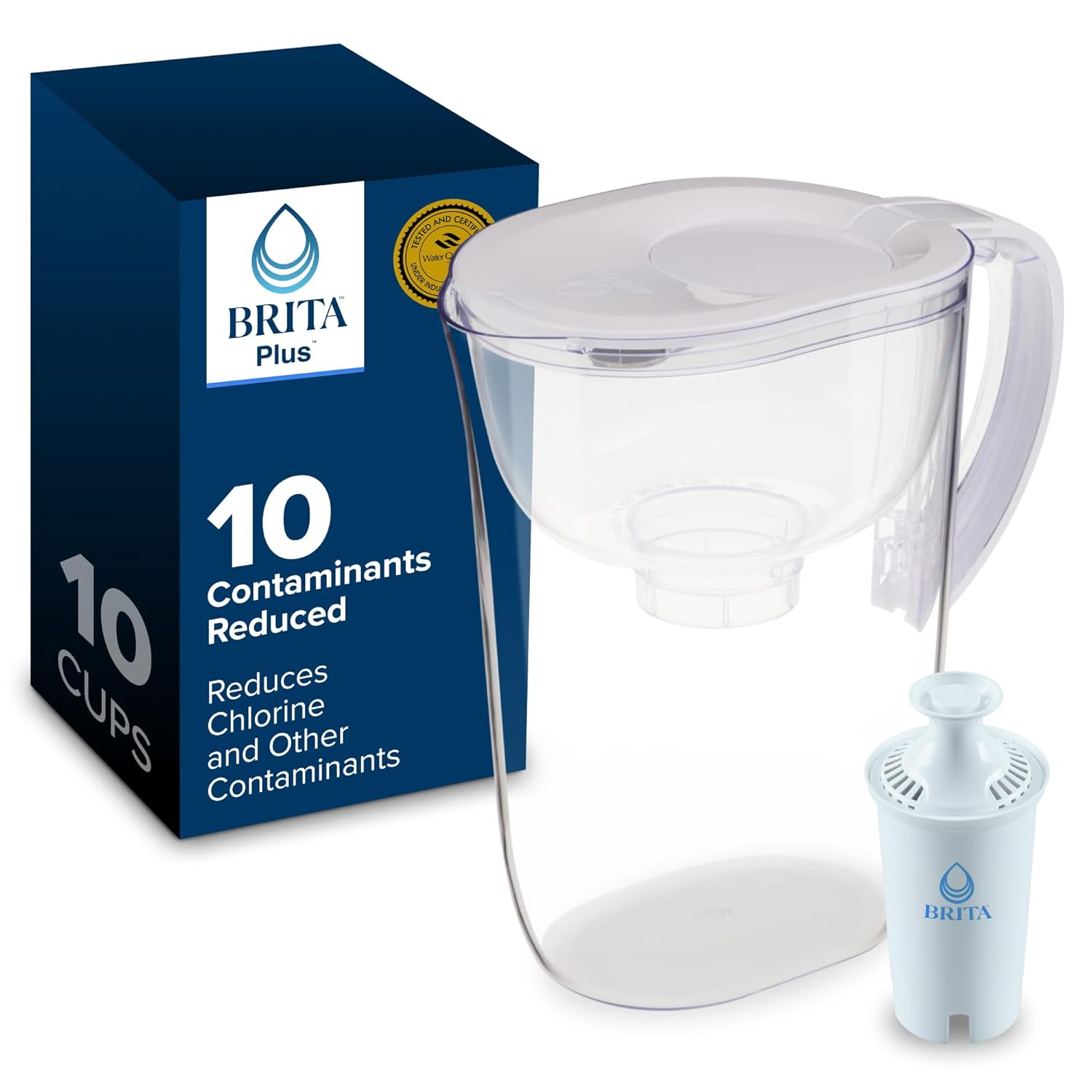
Brita 10-Cup Pitcher with BritaPlus Filter
A 10-cup Brita pitcher that ships with the BritaPlus filter, which Brita positions as a higher-reduction option than its standard filter, with WQA certifications listed on the product.
Pros
- Includes the BritaPlus filter
- WQA/NSF certifications listed by the maker
- Familiar 10-cup pitcher format
How to get the most from a pitcher
- Fill it after dinner so cold water is waiting in the morning.
- Wash the pitcher regularly and replace the filter on schedule; a neglected pitcher does not stay a nice object.
- Keep a spare filter in the cupboard so you are not tempted to keep pouring through an exhausted one.
- Do not freeze a full pitcher, and follow the maker's priming instructions on the first use.
- Recycle or return spent cartridges if the brand offers a mail-back or drop-off program, and otherwise follow your local rules.
A pitcher also pairs naturally with other low-waste kitchen habits. Our guides to saving water at home, plastic-free kitchen swaps and storing emergency water cover the rest of the picture, from the tap to the cupboard.
Frequently Asked Questions
Do I still need a pitcher if my city water already meets standards?
Many people use a pitcher mainly to improve chlorine taste and odor, which is a comfort choice rather than a safety requirement. If you have a specific concern such as lead in an older plumbing system, look for a filter certified for that contaminant.
What is the difference between NSF/ANSI 42 and 53?
Standard 42 covers aesthetic effects such as chlorine taste and odor. Standard 53 covers certain health-related contaminants, including lead when that claim is listed. Always check the exact claims for the filter you buy.
Are pitcher filters certified for PFAS?
Some are, and many are not. Look for a current certification that names PFOA, PFOS or total PFAS. A general "removes chemicals" claim is not the same thing.
How often should I replace the filter?
Follow the maker's capacity or time interval, or the reading on a TDS meter if the pitcher includes one. An overdue filter will not keep performing at its certified level.
Is a glass pitcher better than plastic?
Glass looks handsome and avoids plastic contact, but a BPA-free plastic pitcher that you actually use and wash is still a solid choice. Durability and a lid that seals in the fridge usually matter more than the material debate.