"Panasonic Eneloop Batteries: A Case for Rechargeables"
Disposable AA batteries are a quiet habit with a long tail: a remote here, a flashlight there, a game controller, a wireless mouse, a drawer of half-dead cells you are never quite sure about. Panasonic's Eneloop rechargeable AAs exist to end that cycle. They ship pre-charged, they can be recharged many times, and they have been the default recommendation in this category for years.
This is a research-based review of the standard Eneloop AA eight-pack, not a laboratory cycle test. Capacity and cycle claims belong to the manufacturer, and they depend on how you charge and use the cells. The useful question is simpler: if you already own devices that take AAs, is a reusable set worth the small change in routine? For most households, yes.
The short version
Standard Eneloop cells are nickel-metal hydride (NiMH) AAs that arrive pre-charged, so you can use them immediately. Panasonic rates them for a very large number of recharge cycles under its published test methods. They are an excellent fit for remotes, lights, toys, cameras and the kind of emergency kit that should not depend on a fresh pack of alkalines you bought three years ago.
They are not the right tool for a device that is happier on lithium disposables in extreme cold, or for someone who will not actually recharge them. A forgotten Eneloop in a drawer is still better than a pile of dead alkalines, but the environmental and practical gains arrive when you own a charger and use it.
Why Eneloop became the default
Ordinary rechargeable AAs earned a mixed reputation years ago: they arrived empty, they lost their charge on the shelf, and cheap cells faded quickly. Eneloop's pitch, which the company has held for a long time, is that the cells are pre-charged at the factory and hold that charge reasonably well in storage compared with older NiMH designs. That single habit, "they work the day you need them," is why so many owner reviews treat them as a household staple rather than a hobbyist product.
Panasonic publishes cycle-life figures for the standard Eneloop line (the BK-3MCC family of AA cells). Those figures are measured under specified test methods, and stricter methods produce more conservative numbers. The honest way to read them is not as a guarantee that every cell will last a particular count in your TV remote, but as evidence that these are built for repeated reuse, not a handful of cycles.
For waste, the logic is straightforward. EPA's pages on used batteries encourage managing batteries as a product with an end of life, not as ordinary trash. A small set of cells you recharge for years, then recycle through a program such as Call2Recycle, is a much shorter pile than years of single-use AAs.
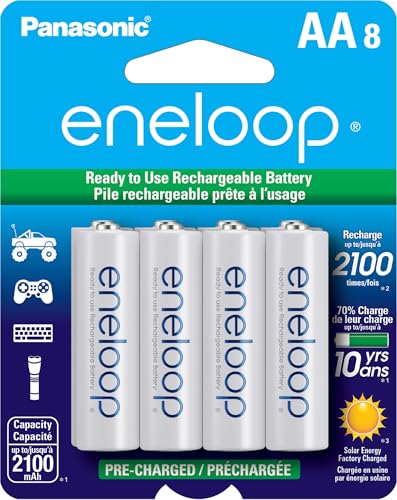
Panasonic Eneloop Rechargeable AA Batteries, 8-Pack
Standard Panasonic Eneloop AA cells, sold as an eight-pack and shipped pre-charged. A practical way to stop buying disposable AAs for remotes, lights, game controllers and emergency kits.
Pros
- Pre-charged nickel-metal hydride cells
- Manufacturer-rated for a very large number of recharge cycles
- A standard AA size that fits everyday devices
Who it is for
- Households with several AA devices and a growing collection of half-used disposables.
- People assembling a solar or battery-powered emergency kit, or thinking through a power outage without a gas generator, where lights and radios should be ready without a last-minute store run.
- Anyone who would rather own a small, repeatable system (cells plus a charger) than keep restocking.
You will want a quality charger made for NiMH cells if you do not already have one. Some Eneloop bundles include a charger; this eight-pack is the cells themselves. That is not a drawback so much as a reminder to budget for the charger once, then stop thinking about it.
Who should skip it
- You have no AA devices. There is nothing to recharge.
- You need AAA, C, D or a camera-specific cell. Buy the size you actually use; Eneloop makes other sizes, but this pack is AA.
- You will not charge them. Rechargeables that live and die as if they were disposable miss the point.
- You need maximum capacity for a high-drain device and already understand the trade-offs. Panasonic's "pro" style cells offer more capacity with a shorter rated cycle life. They are a specialist choice, not a better everyday one for most remotes and toys.
A few habits that make them last
Charge them with a proper NiMH charger, not an old leftover meant only for a different chemistry. Do not leave tired cells sitting in a device that has started to dim; recharge when performance drops. Store spares somewhere dry and moderate, and recycle them when they finally no longer hold a useful charge. Mixing very old cells with new ones in the same device is a needless way to disappoint yourself.
Used thoughtfully, a couple of eight-packs can cover a household's everyday AA needs for a long time. That is the quiet luxury of the thing: fewer packages arriving, fewer mystery batteries in a drawer, and lights that actually work when you reach for them.
Frequently Asked Questions
Do Eneloop batteries come charged?
Yes. Standard Eneloop cells are sold pre-charged, which is a large part of their appeal. A first charge after you start rotating them is still good practice, but you do not have to wait before the first use.
How many times can I recharge them?
Panasonic publishes high cycle-life ratings for the standard line, measured under defined test methods. Real-world life depends on the charger, the device, and how deeply you drain the cells. Treat the published figure as a design claim, not a countdown timer.
Can I use them in an emergency flashlight?
Yes, and they are often a better plan than alkalines that have been sitting for years, provided you recharge them on a schedule and keep a spare set ready.
What do I do with them at the end of their life?
Do not put them in ordinary household trash if a recycling option is available. Use a battery recycling program such as Call2Recycle, or follow your local rules for rechargeable cells.